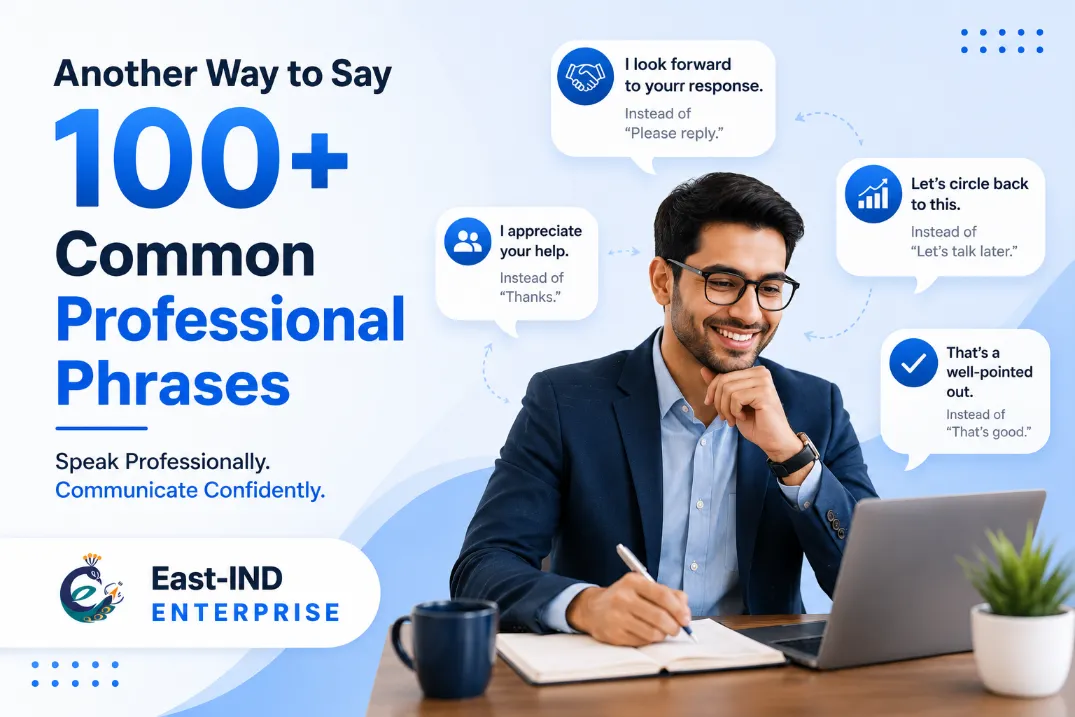
Another Way to Say 100+ Common Phrases Professionally
Expert Byline
SEO Team
Release Date
August 14, 2026
We all have those crutch words. You are typing out an email to a client or preparing for a team sync, and you catch yourself typing "Also," "Make sure," or "Thank you" for the fifth time that day.
Relying on the same basic vocabulary doesn't just make your communication repetitive; it subtly dilutes your professional authority. When you use tired, generic phrases, your message blends into the background noise of a crowded inbox. Finding another way to say common phrases isn't about using a thesaurus to sound pretentious. It is about precision. It is about matching the exact tone of the situation—whether you need to sound assertive, empathetic, or analytical.
In this comprehensive guide, we are tearing down the most overused workplace vocabulary. We have categorized over 100 common phrases and provided you with sharp, professional alternatives, complete with exactly how and when to use them in the real world.
Table Of Contents:
1. Expressions of Gratitude and Greetings
Getting your greetings and sign-offs right sets the entire tone of your professional relationship.
Another way to say "Thank you" (or Another word for thank you)
"Thank you" is classic, but when used constantly, it loses its weight. If you are looking for another term of thank you, another word to say thank you, or another phrase for thank you, try tailoring it to the specific effort the person made.
- Alternatives: I truly appreciate your help, I'm grateful for your insight, Much obliged, The pleasure was mine, Happy to help, No worries.
- How to use it:
- Instead of: "Thank you for the report."
- Try: "I truly appreciate you pulling this report together so quickly." Use "The pleasure was mine" or "Happy to help" when someone thanks you for a collaborative effort, signaling that the work was mutually beneficial.
Detailed Breakdown:
I truly appreciate your help
- When to use it: When a colleague or client goes out of their way to assist you with a specific, actionable task.
- Scenario: A coworker steps in to cover a meeting for you while you are double-booked.
- Example: "I truly appreciate your help covering the sync today; it gave me the time needed to finalize the pitch."
I'm grateful for your insight
- When to use it: When acknowledging someone's intellectual contribution, advice, or feedback rather than physical labor.
- Scenario: A senior manager reviews your presentation and suggests a better strategic angle.
- Example: "I'm grateful for your insight on the pricing slide. I'll make those adjustments right away."
Much obliged
- When to use it: A slightly more formal, slightly traditional way to acknowledge a favor. Great for vendor or external communications.
- Scenario: A vendor rushes an invoice to you before the end of the day.
- Example: "Much obliged for sending this over so quickly before the weekend."
The pleasure was mine
- When to use it: When replying to someone thanking you, elevating the interaction to mutual respect.
- Scenario: A client thanks you for an excellent onboarding call.
- Example: "The pleasure was mine! I look forward to our next steps together."
Happy to help / No worries
- When to use it: In informal, fast-paced internal communications to reassure someone that a small mistake or request was not a burden.
- Scenario: A team member apologizes for asking a simple question on Slack.
- Example: "No worries at all, happy to help clear that up!"
Another way to say "Hello" or "How are you"
Starting every email with "Hi, how are you?" trains people to skim past your opening line.
- Alternatives: I hope this note finds you well, Trust you're having a productive week, It’s great to connect with you.
- How to use it:
- Instead of: "Hello, how are you? I need the files."
- Try: "I hope this note finds you well. Could you send over the Q3 files?" Use this to establish a polite but direct runway into your core message.
Detailed Breakdown:
I hope this note finds you well
- When to use it: The gold standard for cold outreach or contacting someone you haven't spoken to in a while.
- Scenario: Reaching out to a former client with a new proposal.
- Example: "I hope this note finds you well. I’m reaching out because we just launched a new feature..."
Trust you're having a productive week
- When to use it: Mid-week check-ins with ongoing clients or vendors. It sets a business-focused tone immediately.
- Scenario: Following up on a contract on a Wednesday.
- Example: "Trust you're having a productive week. Have you had a chance to review the terms?"
It’s great to connect with you
- When to use it: When replying to an introduction email or reaching out after a networking event.
- Scenario: A mutual colleague introduces you to a potential partner over email.
- Example: "It's great to connect with you, Sarah. John has told me wonderful things about your agency."
Another way of saying "I look forward to"
This is the default email closer, but it can feel incredibly passive.
- Alternatives: I am eager to, I anticipate, I'm excited to collaborate on.
- How to use it:
- Instead of: "I look forward to your reply."
- Try: "I am eager to hear your thoughts on this strategy." This shifts the tone from waiting passively to active enthusiasm.
Detailed Breakdown:
I am eager to
- When to use it: When you want to convey genuine enthusiasm and readiness to start working.
- Scenario: Accepting a new project brief from a client.
- Example: "I am eager to dive into this brief and get the initial drafts over to you by Friday."
I anticipate
- When to use it: In more formal contexts where you expect an action to happen based on agreed terms.
- Scenario: Sending a final invoice after project completion.
- Example: "I anticipate reviewing the signed documents by end of day."
I'm excited to collaborate on
- When to use it: When kicking off a partnership or team project, emphasizing teamwork.
- Scenario: Emailing a new contractor you just hired.
- Example: "I'm excited to collaborate on this upcoming campaign with you."
Another way to say "Good luck" (Another saying for good luck)
"Good luck" implies that success is left to chance. In a professional setting, you want to imply that their skills will bring them success.
- Alternatives: Wishing you the best, I know you'll do great, Here’s to a successful launch.
- How to use it:
- Instead of: "Good luck with the presentation."
- Try: "I know you'll do great in the presentation today—you know this material inside and out."
Detailed Breakdown:
Wishing you the best
- When to use it: A warm, professional sign-off when someone is leaving the company or taking on a new role.
- Scenario: Replying to a colleague's farewell email.
- Example: "Wishing you the best in your new role; they are lucky to have you."
I know you'll do great
- When to use it: When a colleague is nervous about an upcoming performance or pitch.
- Scenario: Messaging a coworker 10 minutes before their big webinar.
- Example: "Take a deep breath! I know you'll do great today."
Here’s to a successful...
- When to use it: Celebrating the kickoff of a long-awaited project.
- Scenario: The morning a new website design goes live.
- Example: "Here's to a successful launch today! The team crushed this."
Another way of saying "Congratulations"
- Alternatives: Commendations on your success, Hats off to you on this milestone, Thrilled to see your hard work pay off.
- How to use it: Use "Thrilled to see your hard work pay off" when acknowledging a colleague's promotion, as it highlights their effort rather than just the event.
Detailed Breakdown:
Commendations on your success
- When to use it: Highly formal, best suited for company-wide announcements or board-level communications.
- Scenario: Emailing a department head after they crushed their quarterly targets.
- Example: "Commendations on your success this quarter. The numbers are outstanding."
Hats off to you on this milestone
- When to use it: A slightly more spirited, friendly acknowledgment of a major achievement.
- Scenario: A colleague celebrates their 5-year work anniversary.
- Example: "Hats off to you on this 5-year milestone! Your dedication is unmatched."
Thrilled to see your hard work pay off
- When to use it: When you personally know how much effort someone put into a goal.
- Scenario: A junior team member finally gets promoted after months of late nights.
- Example: "Thrilled to see your hard work pay off with this promotion. You earned it."
Another way of saying "Merry Christmas"
In modern workplaces, it is often safer and more inclusive to broaden your holiday wishes.
- Alternatives: Season’s greetings, Wishing you a restful holiday season, Warmest wishes for the new year.
- How to use it:
- Instead of: "Merry Christmas to the team."
- Try: "Wishing you all a restful holiday season and a fantastic start to the new year."
Detailed Breakdown:
Season’s greetings
- When to use it: The standard, inclusive fallback for mass emails to external client lists in December.
- Scenario: Sending the company-wide end-of-year newsletter.
- Example: "Season’s greetings from all of us at [Company Name]!"
Wishing you a restful holiday season
- When to use it: Emphasizing well-being and time off, great for internal teams who have worked hard.
- Scenario: Your final Slack message to the team before logging off for a week.
- Example: "Wishing you all a restful holiday season. Please disconnect and enjoy the break."
Warmest wishes for the new year
- When to use it: When the communication happens closer to January, focusing on future success.
- Scenario: Sending a gift basket to a top client in late December.
- Example: "Warmest wishes for the new year. We are excited to grow with you in Q1."
Another way of saying "Welcome home"
Often used when a colleague returns from a long sabbatical, maternity leave, or extended travel.
- Alternatives: It is wonderful to have you back, We missed your energy around here, Glad to see you return.
- How to use it: "It is wonderful to have you back in the office—the team definitely felt your absence!"
Detailed Breakdown:
It is wonderful to have you back
- When to use it: The safest, warmest, and most professional way to welcome someone returning from parental or medical leave.
- Scenario: The first email you send to a returning manager.
- Example: "It is wonderful to have you back! Let's schedule a gentle sync whenever you are settled."
We missed your energy around here
- When to use it: For close colleagues returning from a long vacation.
- Scenario: Greeting a peer who just got back from a two-week honeymoon.
- Example: "Welcome back! We missed your energy around here. Can't wait to hear about the trip."
Glad to see you return
- When to use it: A more formal, reserved welcome for leadership or external partners.
- Scenario: A board member returns from a sabbatical.
- Example: "Glad to see you return to the board meetings; your guidance was missed."
2. Transitions, Additions, and Flow
The words you use to connect ideas dictate how easily your audience digests your message.
Another way to say "Also" (Other ways to say also / Another way of saying also)
If you find yourself starting sentences with "Also," you are likely writing disjointed thoughts. Look for words that build momentum.
- Alternatives: Furthermore, Moreover, Along with this, Equally important.
- How to use it:
- Instead of: "We updated the website. Also, we changed the logo."
- Try: "We updated the website; furthermore, we refreshed the logo to match." Use "Equally important" when introducing a point that shouldn't be overshadowed by the previous one.
Detailed Breakdown:
Furthermore
- When to use it: When adding a logical extension to a previous formal point.
- Scenario: Writing an executive summary for a project phase.
- Example: "The initial tests were successful; furthermore, user retention increased by 10%."
Moreover
- When to use it: When the new information is even more persuasive or heavier than the previous point.
- Scenario: Pitching a software upgrade to a client.
- Example: "The software is faster. Moreover, it includes a security patch that prevents data leaks."
Along with this
- When to use it: When presenting physical or digital deliverables together.
- Scenario: Attaching multiple files to an email.
- Example: "I have attached the contract. Along with this, you will find the appendix for review."
Equally important
- When to use it: When the second item must absolutely not be ignored.
- Scenario: Detailing compliance steps to a team.
- Example: "We must secure the client data. Equally important, we must document every step of the transfer."
Another way to say "Additionally" or "In addition to" (Another way of saying additionally)
- Alternatives: Coupled with, On top of that, As a supplement to.
- How to use it: "Coupled with our new email strategy, this ad spend will drive double the traffic."
Detailed Breakdown:
Coupled with
- When to use it: When showing that two things work powerfully together in synergy.
- Scenario: Explaining a marketing strategy to stakeholders.
- Example: "Our new SEO efforts, coupled with targeted social ads, will dominate the Q2 metrics."
On top of that
- When to use it: In conversational, spoken presentations when adding a bonus benefit.
- Scenario: A sales pitch demo on a Zoom call.
- Example: "It automates your payroll. On top of that, it generates tax forms instantly."
As a supplement to
- When to use it: When introducing an optional but helpful extra resource.
- Scenario: Providing training materials to new hires.
- Example: "As a supplement to the video training, please review this PDF guide."
Another way to say "But" (Different ways to say but / Another way of saying but)
"But" acts as a conversational stop sign. It immediately invalidates whatever you said right before it.
- Alternatives: Although, Nevertheless, That being said, Still.
- How to use it:
- Instead of: "The design looks good, but the colors are wrong."
- Try: "The design structure is solid; that being said, we need to adjust the color palette."
Detailed Breakdown:
Although
- When to use it: To soften a critique by burying the negative in a dependent clause.
- Scenario: Reviewing a flawed draft from a junior writer.
- Example: "Although the structure is perfect, we need to refine the tone in the second paragraph."
Nevertheless
- When to use it: When you intend to push forward despite a known obstacle.
- Scenario: Acknowledging budget constraints during a planning meeting.
- Example: "We have a limited budget; nevertheless, we are committed to launching on time."
That being said
- When to use it: To validate the opposing side completely before introducing your counterpoint.
- Scenario: Negotiating terms with a strict client.
- Example: "I understand your need for a discount. That being said, our margins cannot accommodate a 20% cut."
Still
- When to use it: A gentle, conversational pivot when standing your ground.
- Scenario: Responding to a team member's excuse for a missed deadline.
- Example: "I know the server was down yesterday. Still, we need to have this finalized by noon today."
Another way of saying "However"
- Alternatives: Conversely, In contrast, Nonetheless, On the flip side.
- How to use it: "We saw a dip in Q1 revenue. Nonetheless, our user retention reached an all-time high." Use this when introducing a mitigating positive fact.
Detailed Breakdown:
Conversely
- When to use it: When presenting an exact opposite scenario, often in data analysis.
- Scenario: Reporting A/B test results.
- Example: "Variant A drove clicks. Conversely, Variant B drove actual sales."
In contrast
- When to use it: When making a direct comparison between two distinct entities.
- Scenario: Comparing competitor pricing.
- Example: "Our competitor charges monthly. In contrast, we offer a flat lifetime fee."
Nonetheless
- When to use it: Very similar to "nevertheless"—moving forward despite a negative fact.
- Scenario: Addressing a minor setback to the board.
- Example: "The launch was delayed by 48 hours. Nonetheless, early adoption rates are exceeding expectations."
On the flip side
- When to use it: Conversational tone, examining the pros and cons of an idea.
- Scenario: Brainstorming in a creative meeting.
- Example: "This campaign is expensive. On the flip side, it guarantees national exposure."
Another way to say "On the other hand"
- Alternatives: Alternatively, From a different perspective, Weighing the alternatives.
- How to use it: "We could launch immediately with a few bugs. Alternatively, we could delay by two weeks for a flawless release."
Detailed Breakdown:
Alternatively
- When to use it: Offering a clear Plan B in a professional manner.
- Scenario: Giving a client options for a deliverable.
- Example: "We can handle this via email. Alternatively, we can jump on a quick 10-minute call."
From a different perspective
- When to use it: When trying to reframe a problem a team is stuck on.
- Scenario: A project is stalled due to technical issues.
- Example: "From a different perspective, what if we bypass the API entirely and use a manual upload?"
Weighing the alternatives
- When to use it: When concluding a summary of pros and cons before making a decision.
- Scenario: Concluding a risk-assessment document.
- Example: "Weighing the alternatives, I believe Option A presents the least financial risk."
Another way to say "Instead" (Another word for instead)
- Alternatives: As an alternative, Rather, In lieu of.
- How to use it: "In lieu of a traditional meeting, let's just handle this via a quick Slack huddle."
Detailed Breakdown:
As an alternative
- When to use it: When proposing a replacement idea gently.
- Scenario: Rejecting a vendor's proposed software.
- Example: "We cannot use Tool X. As an alternative, I suggest we look into Tool Y."
Rather
- When to use it: To clarify a misunderstanding or correct a course of action.
- Scenario: Correcting a project timeline.
- Example: "We will not be launching in May. Rather, we are pushing to a mid-June date."
In lieu of
- When to use it: A formal substitution of one physical or conceptual thing for another.
- Scenario: Sending a company-wide policy update.
- Example: "In lieu of our annual physical retreat, we are issuing everyone a $500 wellness stipend."
Another way to say "At the same time"
- Alternatives: Simultaneously, Concurrently, In tandem.
- How to use it: "We need to push the live update and, concurrently, send out the press release."
Detailed Breakdown:
Simultaneously
- When to use it: When two specific events must happen at the exact same moment.
- Scenario: Launching a product across multiple time zones.
- Example: "The website goes live, and simultaneously, the social media blast is triggered."
Concurrently
- When to use it: When two processes or projects are running parallel over a period of time.
- Scenario: Managing two different project phases.
- Example: "We are developing the front-end interface and, concurrently, building out the back-end database."
In tandem
- When to use it: Emphasizing teamwork and coordination between two things or people.
- Scenario: Explaining how two departments will work together.
- Example: "The sales team will work in tandem with marketing to qualify these leads."
Another way of saying "And"
- Alternatives: Along with, Coupled with, Including.
- How to use it: "We will be reviewing the budget, along with the proposed hiring plan."
Detailed Breakdown:
Along with
- When to use it: To attach secondary items to a primary subject gracefully.
- Scenario: Sending meeting minutes.
- Example: "I have attached the agenda, along with the notes from last week."
Including
- When to use it: When giving specific examples of a broader category you just mentioned.
- Scenario: Outlining project deliverables.
- Example: "We will provide all branding assets, including the logo files and font licenses."
Another way of saying "As well as"
- Alternatives: Not to mention, In conjunction with.
- How to use it: "The software improves speed, not to mention it severely cuts down on manual data entry."
Detailed Breakdown:
Not to mention
- When to use it: When adding a highly impressive or impactful bonus point in a conversational tone.
- Scenario: Pitching a service in an email.
- Example: "It saves 10 hours a week, not to mention the reduction in human error."
In conjunction with
- When to use it: Formal documentation indicating two things operate together.
- Scenario: Writing technical instructions.
- Example: "This software must be used in conjunction with a VPN."
Another phrase for "Not only"
- Alternatives: Beyond just, More than simply.
- How to use it:
- Instead of: "Not only is it fast, it's cheap."
- Try: "Beyond just improving our speed, this tool reduces our monthly overhead."
Detailed Breakdown:
Beyond just
- When to use it: Elevating a standard feature to show deeper value.
- Scenario: Writing copy for a product launch.
- Example: "Beyond just organizing your files, it actively predicts what you need next."
More than simply
- When to use it: Dispelling a common misconception about a basic service.
- Scenario: Defending your agency's pricing.
- Example: "We offer more than simply design; we provide full-scale brand strategy."
Another way to say "Lastly"
- Alternatives: Finally, To wrap things up, Ultimately.
- How to use it: "Ultimately, the decision rests with the stakeholders."
Detailed Breakdown:
Finally
- When to use it: Concluding a strict, numbered list in formal writing.
- Scenario: Step 5 of a 5-step instructional guide.
- Example: "Finally, press submit and wait for the confirmation email."
To wrap things up
- When to use it: Spoken transition to signal the end of a meeting or presentation.
- Scenario: You have 5 minutes left on a Zoom call.
- Example: "To wrap things up, let's review the action items for next week."
Ultimately
- When to use it: Presenting the final, most crucial takeaway or deciding factor.
- Scenario: Concluding an analysis of a difficult choice.
- Example: "Ultimately, we have to choose the option that protects user data."
Another way to say "In conclusion"
"In conclusion" belongs in high school essays, not boardroom presentations.
- Alternatives: To summarize, Ultimately, Taking everything into consideration, To bring this all together.
- How to use it:
- Instead of: "In conclusion, we should buy the software."
- Try: "To summarize, investing in this software solves our three main bottleneck issues."
Detailed Breakdown:
To summarize
- When to use it: When you need to condense a long email or report into a 1-sentence takeaway.
- Scenario: The final paragraph of a 4-page strategy brief.
- Example: "To summarize, our Q3 focus must shift heavily toward retention."
Taking everything into consideration
- When to use it: When showing that you have weighed a complex set of pros and cons fairly.
- Scenario: Announcing a difficult management decision.
- Example: "Taking everything into consideration, we have decided to delay the launch."
To bring this all together
- When to use it: During a live presentation, tying various disparate points into one cohesive thesis.
- Scenario: The final slide of your deck.
- Example: "To bring this all together, our design, tech, and marketing must speak with one voice."
3. Cause, Effect, and Clarification
When you are explaining why something happened, clarity is everything.
Another way of saying "As a result"
- Alternatives: Consequently, Therefore, Thus, For this reason.
- How to use it: "The server crashed over the weekend. Consequently, our Monday reporting is delayed." Use "Thus" in more formal, written reports, and "Consequently" in spoken presentations.
Detailed Breakdown:
Consequently
- When to use it: Showing a direct, unavoidable chain reaction in business logic.
- Scenario: Explaining a missed metric to a client.
- Example: "Ad costs rose sharply in May; consequently, our CPA increased by 12%."
Therefore
- When to use it: Formal, logical conclusion based on preceding evidence.
- Scenario: Recommending a course of action in a brief.
- Example: "The data shows high churn in month two. Therefore, we must implement a 30-day check-in protocol."
Thus
- When to use it: Highly formal, best reserved for academic or deep technical whitepapers.
- Scenario: Writing an industry trend report.
- Example: "The algorithm prioritizes video; thus, static image reach has plummeted."
For this reason
- When to use it: A clear, conversational way to link a strict policy to its logical origin.
- Scenario: Explaining a new HR rule to the team.
- Example: "Security breaches are on the rise. For this reason, we are mandating 2FA on all accounts."
Another way to say "Because"
- Alternatives: Due to the fact that, Given that, As a consequence of.
- How to use it: "Given that the deadline was moved up, we will need all hands on deck today."
Detailed Breakdown:
Given that
- When to use it: Setting the stage with a known fact before making a request.
- Scenario: Asking for an extension from a manager.
- Example: "Given that the scope of the project doubled yesterday, I will need until Thursday to finish."
As a consequence of
- When to use it: Highlighting a negative or unintended outcome caused by an event.
- Scenario: Explaining a supply chain issue.
- Example: "As a consequence of the shipping delays, our inventory is running low."
Another way of saying "Due to"
- Alternatives: Stemming from, Brought about by, Owing to.
- How to use it: "The drop in traffic is stemming from the recent algorithm update."
Detailed Breakdown:
Stemming from
- When to use it: Diagnosing the root cause of an ongoing issue.
- Scenario: Post-mortem meeting after a software crash.
- Example: "The login errors are stemming from an outdated API key."
Brought about by
- When to use it: Describing a major change or shift in culture or policy.
- Scenario: Writing a company update newsletter.
- Example: "This new hybrid work model was brought about by team feedback."
Owing to
- When to use it: A formal, slightly British/traditional alternative to "due to."
- Scenario: Legal or formal contractual communications.
- Example: "Owing to unforeseen circumstances, the event has been canceled."
Another way of saying "Because of this"
- Alternatives: Hence, On account of this, Prompted by this.
- How to use it: "Our competitors lowered their prices. Prompted by this, we need to re-evaluate our Q4 offers."
Detailed Breakdown:
Prompted by this
- When to use it: Showing that you took proactive action based on a specific event.
- Scenario: Explaining a strategic pivot to stakeholders.
- Example: "User feedback was highly critical of the interface. Prompted by this, we expedited the UX redesign."
On account of this
- When to use it: Explaining a limitation or change in plans formally.
- Scenario: Rescheduling a meeting.
- Example: "The CEO has been called out of town. On account of this, we will move our sync to next week."
Another way to say "For example" or "Such as" (Different ways to say for example)
"For example" gets incredibly repetitive in long instructional documents.
- Alternatives: For instance, To illustrate, As a case in point, Namely.
- How to use it:
- Instead of: "We have many features, for example, dark mode."
- Try: "We offer several customization options; to illustrate, users can toggle dark mode on or off." Use "Namely" when you are about to list the exact specific items you just vaguely referenced.
Detailed Breakdown:
For instance
- When to use it: A direct, slightly more polished 1:1 replacement for "for example."
- Scenario: Writing a blog post or instructional text.
- Example: "There are many ways to automate tasks; for instance, using Zapier to route emails."
To illustrate
- When to use it: Before telling a short story, showing a graph, or giving a highly detailed scenario.
- Scenario: Transitioning to a case study in a pitch deck.
- Example: "To illustrate how this works, let's look at what happened with Client X."
As a case in point
- When to use it: Pointing to a real-world event that perfectly proves the statement you just made.
- Scenario: Arguing for better cybersecurity.
- Example: "Phishing attacks can cripple a business. As a case in point, look at the recent massive breach at Corporation Y."
Namely
- When to use it: Transitioning from a vague plural noun to the specific exact items.
- Scenario: Clarifying exactly who is affected by a policy.
- Example: "This update applies to all senior management, namely Directors and VPs."
Another phrase for "In other words" (Another way to say in other words)
- Alternatives: To clarify, Put simply, To distill it down.
- How to use it: "The API is returning a 500 error. Put simply, our system can't talk to their system right now."
Detailed Breakdown:
To clarify
- When to use it: When you realize your previous statement was too complex or jargon-heavy.
- Scenario: Pausing during a technical explanation to non-technical stakeholders.
- Example: "To clarify, this means the website will load three seconds faster for mobile users."
Put simply
- When to use it: Summarizing a dense, lengthy paragraph into one punchy takeaway.
- Scenario: The TL;DR at the top of an email.
- Example: "Put simply, if we don't increase ad spend now, we will miss our Q4 targets."
To distill it down
- When to use it: Synthesizing hours of meeting notes or pages of data into the core essence.
- Scenario: Reporting back to the CEO after a 3-day conference.
- Example: "To distill it down to the core trend: AI is automating our entry-level tasks."
Another way to say "This shows" or "This means"
- Alternatives: This indicates, This demonstrates, This implies, This translates to.
- How to use it:
- Instead of: "Traffic is up. This means the ad worked."
- Try: "Traffic increased by 40%. This indicates that our new creative resonated with the target demographic."
Detailed Breakdown:
This indicates
- When to use it: Pointing to a strong probability based on data, without claiming 100% absolute proof.
- Scenario: Analyzing a dip in website traffic.
- Example: "Bounce rates are up 20% on mobile. This indicates our new layout is not phone-friendly."
This demonstrates
- When to use it: Pointing to absolute, undeniable proof of concept.
- Scenario: Showing successful campaign results.
- Example: "We hit our goal in 10 days. This demonstrates the immense demand for this feature."
This translates to
- When to use it: Moving from an abstract metric to a tangible business result (usually time or money).
- Scenario: Pitching the ROI of your software to a CFO.
- Example: "We save your team 5 hours a week. This translates to $10,000 in saved payroll annually."
Another way to say "According to" or "Based on" (Another way of saying based on)
- Alternatives: As stated by, In alignment with, Drawing from.
- How to use it: "Drawing from the latest digital marketing trends, we need to pivot our budget toward short-form video."
Detailed Breakdown:
As stated by
- When to use it: Directly quoting or referencing a specific authority figure or document.
- Scenario: Referencing the employee handbook.
- Example: "As stated by the updated HR policy, remote work is now allowed twice a week."
In alignment with
- When to use it: Showing that your new idea matches the company's core values or previous goals.
- Scenario: Pitching a new eco-friendly initiative.
- Example: "In alignment with our sustainability goals, we are switching to recycled packaging."
Drawing from
- When to use it: Synthesizing information from a broad report or collection of data to make your point.
- Scenario: Building a strategy based on market research.
- Example: "Drawing from the recent Q2 industry reports, we are seeing a shift toward mobile commerce."
4. Opinions, Agreement, and Perspectives
Professionals need to state their opinions firmly without sounding aggressive, and agree with others without sounding subservient.
Another way to say "I think" or "I believe" (Another way of saying I think)
"I think" undermines your authority. It introduces doubt before you have even made your point.
- Alternatives: I am confident that, My perspective is, Based on the data, it appears that, I maintain that.
- How to use it:
- Instead of: "I think we should delay the launch."
- Try: "Based on the unresolved bugs, I am confident that delaying the launch by one week is our safest route."
Detailed Breakdown:
I am confident that
- When to use it: Asserting leadership and taking ownership of a strong recommendation.
- Scenario: Recommending a hire to the executive team.
- Example: "I am confident that Sarah has the exact skill set we need to lead this division."
My perspective is
- When to use it: Introducing your opinion in a collaborative meeting without shutting down other ideas.
- Scenario: A roundtable discussion on a subjective design choice.
- Example: "My perspective is that the blue logo feels more trustworthy, but I'm open to testing it."
Based on the data, it appears that
- When to use it: Removing emotion entirely and letting the analytics speak for you.
- Scenario: Defending a budget cut.
- Example: "Based on the data, it appears that this marketing channel is no longer profitable."
I maintain that
- When to use it: Standing your ground respectfully when someone challenges your previous point.
- Scenario: Pushing back during a heated strategy debate.
- Example: "I hear your concerns, but I maintain that changing vendors now will cause too much disruption."
Another way of saying "In my opinion"
- Alternatives: From my standpoint, As I see it, To my mind.
- How to use it: "From my standpoint, re-allocating the budget to Q2 will yield a higher ROI."
Detailed Breakdown:
From my standpoint
- When to use it: Framing your opinion based on your unique role or expertise in the company (e.g., as the developer, as the marketer).
- Scenario: A developer explaining a timeline to a sales team.
- Example: "From my standpoint in engineering, that feature will take at least three weeks to build securely."
As I see it
- When to use it: Conversational, laying out a logical pathway or summary of a situation.
- Scenario: Wrapping up a brainstorming session.
- Example: "As I see it, we have two viable options moving forward."
To my mind
- When to use it: A slightly more contemplative, thoughtful way to introduce an idea.
- Scenario: Analyzing a competitor's confusing move.
- Example: "To my mind, their pricing change signals that they are moving upmarket."
Another way of saying "I feel"
- Alternatives: My impression is, I am inclined to believe.
- How to use it: "I am inclined to believe that the client is looking for a cheaper option, not a better one."
Detailed Breakdown:
My impression is
- When to use it: Sharing a gut feeling or reading of a situation based on nuance and observation.
- Scenario: Debriefing with your team immediately after a client pitch.
- Example: "My impression is that they loved the design, but were hesitant about the timeline."
I am inclined to believe
- When to use it: When you are leaning towards a conclusion but acknowledge you don't have 100% of the facts yet.
- Scenario: Troubleshooting a glitch that hasn't been fully diagnosed.
- Example: "I am inclined to believe this is a server issue, but I have IT running a diagnostic now."
Another way to say "I agree"
- Alternatives: I am completely aligned with that, We are on the same page, I second that.
- How to use it:
- Instead of: "I agree with John."
- Try: "I am completely aligned with John's approach on this." Use "We are on the same page" to confirm mutual understanding after a long debate.
Detailed Breakdown:
I am completely aligned with that
- When to use it: Showing strong, strategic unity with leadership or a colleague's plan.
- Scenario: A CEO proposes a new company direction.
- Example: "I am completely aligned with that vision; it perfectly matches our Q3 goals."
We are on the same page
- When to use it: Confirming mutual understanding, often used to close out a clarifying discussion.
- Scenario: Finishing a long back-and-forth Slack thread about a confusing brief.
- Example: "Perfect, looks like we are on the same page now. I'll get started."
I second that
- When to use it: Quick, supportive validation of a peer's idea in a group setting.
- Scenario: A colleague suggests ordering lunch for the team working late.
- Example: "I second that idea! Let's get pizza."
Another word for "Say" or "Said" (Alternative words to said / Different words for say)
If you are writing a report or quoting someone, "said" gets incredibly monotonous. (If you are looking for another word for saying in an essay, this is critical).
- Alternatives: Articulated, Expressed, Mentioned, Clarified, Reiterated.
- How to use it: "During the meeting, Sarah reiterated that the timeline is strictly non-negotiable."
Detailed Breakdown:
Articulated
- When to use it: When someone explained a complex idea very clearly and eloquently.
- Scenario: Praising a colleague's presentation in a follow-up email.
- Example: "John articulated the new product roadmap perfectly on yesterday's call."
Clarified
- When to use it: When someone cleared up a misunderstanding or provided missing details.
- Scenario: Updating a team on a client's revised demands.
- Example: "The client clarified that they only need the first two phases delivered by Friday."
Reiterated
- When to use it: When someone repeated a crucial point to ensure it wasn't ignored.
- Scenario: Writing meeting minutes highlighting a strict boundary.
- Example: "Management reiterated that budgets are frozen until January."
Another way of saying "I" or "I am"
Relying too much on "I" makes communication sound self-centered. Shift the focus to the team or the work.
- Alternatives: The team is, We are currently, My current focus is.
- How to use it:
- Instead of: "I am working on the presentation."
- Try: "My current focus is finalizing the presentation deck."
Detailed Breakdown:
The team is / We are currently
- When to use it: When you are the spokesperson for a project, ensuring credit is distributed.
- Scenario: Updating a client on progress.
- Example: "The team is currently finalizing the code, and we expect to ship it tomorrow."
My current focus is
- When to use it: When explaining your personal workflow without sounding defensive.
- Scenario: A manager asks what you are working on today.
- Example: "My current focus is auditing the Q1 analytics, which I'll have done by 3 PM."
Another way of saying "I will"
- Alternatives: I plan to, My intention is to, You can expect me to.
- How to use it: "You can expect me to deliver the final draft by 4 PM tomorrow."
Detailed Breakdown:
I plan to
- When to use it: Outlining your schedule or strategy to a manager for approval.
- Scenario: Monday morning sprint planning.
- Example: "I plan to tackle the blog rewrites first, then move on to the social copy."
You can expect me to
- When to use it: Setting a hard, reliable expectation for a client or stakeholder.
- Scenario: Committing to a delivery timeline.
- Example: "You can expect me to send the revised contract over by EOD tomorrow."
5. Directives, Actions, and Requests
How you ask someone to do something is the difference between being a leader and being a micromanager.
Another way to say "Make sure" or "Another phrase for make sure" (Another way of saying make sure)
"Make sure" sounds like you are talking to a child or micromanaging a peer.
- Alternatives: Please verify, Ensure that, Could you double-check, Take care to.
- How to use it:
- Instead of: "Make sure the links work before you send the email."
- Try: "Please verify that all the links are functional before hitting send."
Detailed Breakdown:
Please verify
- When to use it: When you need someone to confirm a technical detail or fact.
- Scenario: Asking an assistant to check an itinerary.
- Example: "Please verify that the flight times haven't changed before booking the hotel."
Ensure that
- When to use it: A formal, standard directive for standard operating procedures (SOPs) and guidelines.
- Scenario: Writing an internal process document.
- Example: "Ensure that the client signs the NDA before sharing the deck."
Could you double-check
- When to use it: A polite, collaborative way to ask a peer to review work to catch potential human error.
- Scenario: Asking a coworker to proofread your math.
- Example: "Could you double-check the formula in column B? The totals look slightly off."
Take care to
- When to use it: Advising caution regarding a sensitive or easily mishandled task.
- Scenario: Handing over a delicate client relationship to an account manager.
- Example: "Take care to CC the CEO on all correspondence regarding this account."
Another way to say "Look for"
- Alternatives: Keep an eye out for, Identify, Track down, Source.
- How to use it: "We need to source a new vendor for the packaging materials by Friday."
Detailed Breakdown:
Keep an eye out for
- When to use it: Casual, asking a team to be vigilant for an incoming event or email.
- Scenario: Waiting for an important approval.
- Example: "Keep an eye out for an email from Legal; we need to jump on it as soon as it arrives."
Identify
- When to use it: Analytical task requiring someone to find a specific pattern or problem in data.
- Scenario: Assigning a QA task to a developer.
- Example: "Please review the user logs and identify where the drop-off is happening."
Source
- When to use it: specifically for procurement, recruitment, or finding materials/people.
- Scenario: Asking HR or operations for help.
- Example: "We need to source three freelance designers to help with the overflow this month."
Another way to say "Find out"
- Alternatives: Determine, Ascertain, Uncover, Investigate.
- How to use it: "Could you investigate why the server latency spiked at 2 AM?"
Detailed Breakdown:
Determine
- When to use it: Asking someone to make a final ruling or calculation based on facts.
- Scenario: Asking accounting for a budget update.
- Example: "Please look at the Q2 spend and determine if we have enough budget for the software."
Ascertain
- When to use it: Highly formal, meaning to find something out for certain.
- Scenario: Legal or compliance instructions.
- Example: "We must ascertain whether they hold the copyright before publishing the image."
Investigate
- When to use it: When there is a problem, bug, or mystery that requires deep diving to solve.
- Scenario: Addressing a sudden spike in customer complaints.
- Example: "Customer churn spiked yesterday. Please investigate the cause immediately."
Another way to say "Reach out"
"Reach out" has become one of the most hated pieces of corporate jargon.
- Alternatives: Contact, Get in touch with, Connect with, Initiate a conversation.
- How to use it:
- Instead of: "I'll reach out to the client."
- Try: "I'll initiate a conversation with the client to see where they stand on the social media matrix proposal."
Detailed Breakdown:
Contact
- When to use it: The simplest, most direct, and most professional action verb.
- Scenario: Instructing a sales rep.
- Example: "Please contact the leads on this list by EOD."
Connect with
- When to use it: Implying a networking, relationship-building, or collaborative meeting rather than a transactional call.
- Scenario: Introducing two people.
- Example: "You should connect with Sarah in marketing; she led a similar project last year."
Initiate a conversation
- When to use it: When the goal isn't just to talk, but to carefully start a delicate or strategic dialogue.
- Scenario: Dealing with a client who is unhappy with pricing.
- Example: "I will initiate a conversation with them tomorrow to renegotiate the terms."
Another way to say "Please"
Sometimes "please" can sound like begging if overused, or passive-aggressive if placed wrongly.
- Alternatives: Kindly, I would appreciate it if you could, If you don't mind.
- How to use it: "Kindly review the attached document before our 3 PM call."
Detailed Breakdown:
Kindly
- When to use it: A formal, firm, but polite directive often used by management or customer service.
- Scenario: Instructing a user to perform an action.
- Example: "Kindly fill out the attached intake form before your appointment."
I would appreciate it if you could
- When to use it: Softening a request that requires someone to go slightly out of their way.
- Scenario: Asking a coworker for a favor outside their normal duties.
- Example: "I would appreciate it if you could pull that data for me before the weekend."
If you don't mind
- When to use it: A very deferential, polite way to ask for a small adjustment.
- Scenario: Asking someone to alter their behavior slightly in a meeting.
- Example: "If you don't mind, could we mute our microphones while the client is speaking?"
Another way to say "Research"
- Alternatives: Analyze, Investigate, Delve into, Conduct an inquiry.
- How to use it: "We need to delve into the competitor data before finalizing our pricing."
Detailed Breakdown:
Analyze
- When to use it: Looking deeply at existing data or numbers to draw a conclusion.
- Scenario: Handing an Excel sheet to an analyst.
- Example: "Please analyze the Q1 sales data and look for geographic trends."
Delve into
- When to use it: Conversational, implying a deep, immersive exploration of a topic.
- Scenario: Suggesting a topic for a content team.
- Example: "We need to delve into the psychology behind cart abandonment for our next blog."
Conduct an inquiry
- When to use it: Formal, usually related to HR, legal, or severe operational failures.
- Scenario: Addressing a major security breach.
- Example: "The board has hired an external firm to conduct an inquiry into the data leak."
Another way to say "Show"
- Alternatives: Illustrate, Demonstrate, Reveal, Highlight.
- How to use it: "This new graph illustrates the massive drop in user churn."
Detailed Breakdown:
Illustrate
- When to use it: When using visual aids (charts, graphs, metaphors) to make a point clear.
- Scenario: Presenting data in a slide deck.
- Example: "The chart on page 4 illustrates the correlation between ad spend and traffic."
Demonstrate
- When to use it: Showing a physical action, a software walkthrough, or proving a capability.
- Scenario: A sales pitch for a SaaS product.
- Example: "Let me share my screen to demonstrate how easily the onboarding process works."
Highlight
- When to use it: Drawing specific attention to the most important part of a larger document or concept.
- Scenario: Summarizing a 50-page report.
- Example: "I want to highlight the three key risk factors mentioned in chapter two."
Another way of saying "For your information" (FYI)
"FYI" often comes across as abrupt or passive-aggressive in corporate emails.
- Alternatives: Just to keep you in the loop, For your reference, As a quick update.
- How to use it: "Just to keep you in the loop, the client pushed the meeting to Thursday."
Detailed Breakdown:
Just to keep you in the loop
- When to use it: Friendly, horizontal communication informing a peer of something they don't need to act on.
- Scenario: CCing a colleague on an email thread they might need context on later.
- Example: "Just to keep you in the loop, I’ve approved their vacation request."
For your reference
- When to use it: Providing documents, guidelines, or past examples that might aid their current work.
- Scenario: Attaching brand guidelines to a designer.
- Example: "I've attached last year's deck for your reference as you build this one."
As a quick update
- When to use it: Providing a fast status check on an ongoing project without requiring a reply.
- Scenario: Messaging a stakeholder on Friday afternoon.
- Example: "As a quick update, the code is in staging and will deploy Monday."
6. Descriptive and Impactful Adjectives
Stop using generic adjectives. "Good" and "Bad" don't give your team or your clients any actionable context.
Another way to say "Good" or "Great" (Another way of saying great)
- Alternatives: Exceptional, Superb, Highly effective, Proficient, Stellar.
- How to use it:
- Instead of: "That was a good presentation."
- Try: "That presentation was highly effective—you nailed the pain points perfectly." If you are answering digital marketing interview questions, describing a past campaign as "highly effective" sounds vastly more professional than "a good campaign."
Detailed Breakdown:
Highly effective
- When to use it: When praising work that drove tangible, measurable results.
- Scenario: Reviewing an ad campaign.
- Example: "The new email sequence was highly effective at recovering abandoned carts."
Exceptional / Stellar
- When to use it: When someone goes far above and beyond the standard expectation.
- Scenario: Writing a performance review for a top employee.
- Example: "Your handling of the client crisis yesterday was exceptional."
Proficient
- When to use it: Formal evaluation of someone's hard skills (technical, language, software).
- Scenario: Writing a recommendation letter.
- Example: "Sarah is highly proficient in Python and data visualization."
Another way to say "Important"
- Alternatives: Crucial, Vital, Essential, Mission-critical, Paramount.
- How to use it: "Fixing this payment gateway bug is mission-critical; prioritize it above all else today."
Detailed Breakdown:
Mission-critical
- When to use it: When failure to act will result in catastrophic failure of a project or business.
- Scenario: Alerting dev ops to a server outage.
- Example: "Restoring the database is mission-critical; pause all other tasks."
Essential
- When to use it: Describing something that is a core requirement, without which a process cannot happen.
- Scenario: Listing job requirements.
- Example: "Excellent written communication is essential for this role."
Paramount
- When to use it: Formal, emphasizing that this is the absolute highest priority above everything else.
- Scenario: Writing a company-wide memo on safety.
- Example: "The physical safety of our warehouse staff is paramount."
Another way to say "Meaningful" or "Valuable"
- Alternatives: Impactful, Substantial, Significant, Highly beneficial.
- How to use it: "Sarah's contribution to the UX redesign was highly beneficial to the project's success."
Detailed Breakdown:
Impactful
- When to use it: When describing an action, campaign, or idea that caused a wide ripple effect.
- Scenario: Praising a keynote speech.
- Example: "Your presentation on diversity was incredibly impactful for the team."
Substantial
- When to use it: Referring to weight, volume, or a physical/financial amount of value.
- Scenario: Discussing an investment or return.
- Example: "The new partnership has driven a substantial increase in quarterly revenue."
Highly beneficial
- When to use it: When explaining the positive outcome of adopting a new tool or process.
- Scenario: Pitching a new software to the team.
- Example: "Adopting this project management tool will be highly beneficial to our remote collaboration."
Another way to say "Beautiful" (in a business context)
If you are reviewing design, UI, or creative work, "beautiful" is too vague.
- Alternatives: Aesthetically pleasing, Visually striking, Elegant, Sleek, Well-crafted.
- How to use it: "The new app interface is incredibly sleek and modern."
Detailed Breakdown:
Aesthetically pleasing
- When to use it: A formal, objective way to describe design that follows good visual principles.
- Scenario: Providing feedback to an agency.
- Example: "The new landing page is highly functional and aesthetically pleasing."
Visually striking
- When to use it: When a design is bold, captures attention immediately, and stands out.
- Scenario: Reviewing billboard or ad creative.
- Example: "The neon color palette is visually striking and will definitely stop the scroll."
Sleek / Elegant
- When to use it: Describing minimalist, premium, or highly polished digital interfaces or products.
- Scenario: Reviewing a high-end e-commerce site layout.
- Example: "The checkout flow is elegant and removes all friction for the user."
Another way to say "High quality"
- Alternatives: Premium, Top-tier, Exceptional standard, Superior.
- How to use it: "We only partner with vendors who can guarantee a premium output."
Detailed Breakdown:
Premium
- When to use it: When describing a service, product, or tier that commands a higher price point.
- Scenario: Writing copy for a pricing page.
- Example: "Our enterprise tier includes 24/7 premium support."
Top-tier
- When to use it: Describing talent, agencies, or industry-leading solutions.
- Scenario: Justifying the cost of hiring an expensive consultant.
- Example: "We need a top-tier developer to fix this architecture."
Exceptional standard
- When to use it: Referring to quality control, consistency, and operational excellence.
- Scenario: Writing an ISO compliance manual or QA document.
- Example: "All parts must be manufactured to an exceptional standard before shipping."
Another way to say "Thought-provoking"
- Alternatives: Stimulating, Compelling, Intriguing.
- How to use it: "The keynote speaker raised some incredibly compelling points about automation."
Detailed Breakdown:
Compelling
- When to use it: When an argument or piece of content is so strong it practically forces you to agree or take action.
- Scenario: Reviewing a sales pitch or legal argument.
- Example: "Your data on market expansion presents a compelling case for opening a London office."
Intriguing
- When to use it: When an idea sparks curiosity and makes you want to investigate further, though you aren't fully convinced yet.
- Scenario: Replying to a cold pitch from a startup.
- Example: "Your software’s approach to AI is intriguing. I’d like to see a demo."
Another way to say "A lot" or "So much"
- Alternatives: A substantial amount, A significant portion, An abundance of, Considerably.
- How to use it:
- Instead of: "We lost a lot of traffic."
- Try: "We experienced a significant drop in web traffic."
Detailed Breakdown:
A substantial amount
- When to use it: When referring to unquantified but heavy volumes of work, money, or data.
- Scenario: Explaining why a project is delayed.
- Example: "There is a substantial amount of technical debt we need to clear first."
A significant portion
- When to use it: When referring to a large fraction of a whole (people, pie charts, demographics).
- Scenario: Analyzing customer surveys.
- Example: "A significant portion of our users are logging in via mobile."
Considerably
- When to use it: As an adverb to show a massive difference in degree.
- Scenario: Comparing year-over-year growth.
- Example: "Our Q4 profits were considerably higher than projected."
Another way to say "Ok"
- Alternatives: Acceptable, Satisfactory, Approved, Acknowledged.
- How to use it: "I have reviewed the draft, and it is approved for publication."
Detailed Breakdown:
Approved
- When to use it: When you are the final sign-off giving the green light for an action.
- Scenario: Replying to an expense report or design proof.
- Example: "The budget for the offsite is approved. You may proceed with booking."
Acknowledged
- When to use it: When you receive information that requires no action, but you need to confirm receipt.
- Scenario: IT sends an alert that the servers will be down at midnight.
- Example: "Acknowledged. I will log off before 11:30 PM."
Satisfactory
- When to use it: Formal evaluation indicating that the minimum requirements were met, though it implies it wasn't exceptional.
- Scenario: A vendor performance review.
- Example: "The caterer's performance was satisfactory, but we may look elsewhere next year."
7. Business and Workplace Nuances
Certain phrases are unique to corporate environments, but they quickly become tired buzzwords.
Another way to say "Customer service" (Another way of saying customer service)
- Alternatives: Client success, Customer care, Client relations, Support operations.
- How to use it: "Our client success team will handle the onboarding process for you."
Detailed Breakdown:
Client success
- When to use it: In B2B or SaaS environments where the goal is helping the user proactively achieve ROI with your tool.
- Scenario: Introducing a new client to their account manager.
- Example: "I will hand you over to Sarah in Client Success to get your team trained."
Support operations
- When to use it: Referring to the technical, back-end team handling bug tickets and IT issues.
- Scenario: Answering a complex user complaint.
- Example: "I am escalating this ticket to Support Operations to look at your database."
Client relations
- When to use it: High-touch, relationship-based roles often found in PR, luxury goods, or bespoke agencies.
- Scenario: Discussing the retention strategy for VIP accounts.
- Example: "We need to improve our client relations by scheduling quarterly dinners."
Another way to say "Dealing with"
"Dealing with" sounds like the subject is a massive burden or annoyance.
- Alternatives: Managing, Handling, Navigating, Addressing.
- How to use it:
- Instead of: "I am dealing with the angry client."
- Try: "I am currently navigating a complex situation with the client."
Detailed Breakdown:
Navigating
- When to use it: When describing a situation that is complex, sensitive, and requires tact (like politics or angry clients).
- Scenario: Explaining a delay caused by bureaucratic red tape.
- Example: "We are currently navigating a few compliance roadblocks with legal."
Addressing
- When to use it: Taking direct action to fix a known flaw, bug, or complaint.
- Scenario: Updating a client on a software glitch.
- Example: "The engineering team is actively addressing the login issue."
Managing
- When to use it: Describing oversight of a process, team, or workload.
- Scenario: Outlining your current responsibilities in an interview.
- Example: "I am currently managing the transition to the new CRM."
Another way to say "Positive attitude"
- Alternatives: Constructive mindset, Optimistic approach, Solution-oriented demeanor.
- How to use it: "We hired him primarily because of his solution-oriented demeanor during the trial project."
Detailed Breakdown:
Solution-oriented
- When to use it: Praising someone who doesn't just complain about problems, but brings answers.
- Scenario: Writing a recommendation or giving feedback.
- Example: "I appreciate how solution-oriented you were when the vendor backed out."
Constructive mindset
- When to use it: When discussing how someone handles criticism or difficult feedback.
- Scenario: A manager evaluating a junior designer.
- Example: "She takes feedback with a constructive mindset and applies it immediately."
Another way to say "Products"
- Alternatives: Offerings, Solutions, Deliverables, Merchandise.
- How to use it: "We are expanding our software offerings in Q3."
Detailed Breakdown:
Solutions
- When to use it: In B2B sales, implying that your product actively fixes a client's specific pain point.
- Scenario: Writing a sales pitch.
- Example: "Our enterprise solutions are designed to automate your HR department."
Deliverables
- When to use it: In agency or consulting environments, referring to the specific files, reports, or assets promised in a contract.
- Scenario: Sending an update to a client.
- Example: "The final deliverables, including the logo files, will be sent on Friday."
Offerings
- When to use it: A broad term that encompasses both physical products and services a company provides.
- Scenario: Updating your company's "About Us" page.
- Example: "We have expanded our service offerings to include SEO management."
Another way to say "What"
When asking for clarification, a blunt "What?" comes off as rude.
- Alternatives: Could you clarify that? I didn't quite catch that, Would you mind expanding on that point?
- How to use it: "I didn't quite catch the final metric you mentioned—could you clarify that?"
Detailed Breakdown:
I didn't quite catch that
- When to use it: Polite, conversational way to ask someone to repeat themselves because of audio issues or speed.
- Scenario: Someone speaks too fast on a Zoom call.
- Example: "I didn't quite catch that last number; could you repeat the Q3 figures?"
Could you clarify that?
- When to use it: When you heard the words, but the meaning or logic was confusing.
- Scenario: A client gives vague feedback on a design.
- Example: "Could you clarify what you mean when you say you want it to look 'more pop'?"
Would you mind expanding on that point?
- When to use it: When someone makes an interesting point but stops too soon, and you want them to dive deeper.
- Scenario: A team member suggests a new strategy in a meeting.
- Example: "That's an interesting angle on user retention. Would you mind expanding on that point?"
Another way of saying "Make a difference"
- Alternatives: Move the needle, Drive impact, Effect positive change.
- How to use it: "If we want to actually move the needle on our Q4 revenue, we need to abandon this strategy."
Detailed Breakdown:
Move the needle
- When to use it: A common corporate idiom used when referring to making a noticeable, measurable change in KPIs or revenue.
- Scenario: Evaluating the ROI of a small ad campaign.
- Example: "This $500 ad spend isn't going to move the needle; we need to rethink the budget."
Drive impact
- When to use it: Focused on leadership, high-level strategy, or creating systemic change.
- Scenario: Writing a cover letter for a leadership role.
- Example: "I am looking for a role where I can drive impact at the operational level."
Effect positive change
- When to use it: Usually reserved for HR, non-profits, or internal company culture initiatives.
- Scenario: Launching a new diversity and inclusion program.
- Example: "This committee was formed to effect positive change in our hiring practices."
Another way to say "When it comes to"
- Alternatives: Regarding, Pertaining to, In the context of.
- How to use it: "Regarding the new budget cuts, we need to freeze all contractor hiring."
Detailed Breakdown:
Regarding
- When to use it: The absolute best, most direct way to introduce a topic at the beginning of an email.
- Scenario: Starting an email reply about a specific issue.
- Example: "Regarding your question about the invoice, it was paid on Tuesday."
Pertaining to
- When to use it: Highly formal, often used in legal, compliance, or strict policy documents.
- Scenario: A memo from the legal department.
- Example: "Please review the attached documents pertaining to the NDA violation."
In the context of
- When to use it: When you need to narrow the focus of a broad conversation down to a specific lens.
- Scenario: Discussing a software feature during a broad marketing meeting.
- Example: "In the context of mobile users, this checkout flow is far too slow."
Another way to say "This is" or "Another way to say this" (Other ways to say this / Another way of saying this)
When pointing something out or redefining a concept. (If you want to say it another way or find another way to say it is).
- Alternatives: What we are looking at is, To frame this differently, Essentially.
- How to use it: "To frame this differently, the issue isn't our software; it's the user onboarding process."
Detailed Breakdown:
To frame this differently
- When to use it: When your first explanation failed to land, or you want to shift the perspective of the room.
- Scenario: A client doesn't understand the value of SEO compared to paid ads.
- Example: "To frame this differently, paid ads are renting an audience; SEO is owning the real estate."
What we are looking at is
- When to use it: When literally presenting visual evidence, data, or diagnosing a core problem.
- Scenario: Presenting a Google Analytics chart.
- Example: "What we are looking at is a 40% drop in traffic over the weekend."
Essentially
- When to use it: Boiling a complex, multi-layered situation down to its absolute core truth.
- Scenario: Explaining a massive corporate merger to your team.
- Example: "Essentially, we will operate as an independent studio under their umbrella."
Another way to say "Things" or "Something" (Another way to say something)
"Things" is the laziest noun in the English language. Be specific.
- Alternatives: Elements, Factors, Components, Variables, Issues.
- How to use it:
- Instead of: "We have a few things to fix."
- Try: "We have three main components to fix before launch."
Detailed Breakdown:
Variables
- When to use it: When discussing unknown, shifting elements that can change the outcome of a project.
- Scenario: Discussing the timeline for an uncertain project.
- Example: "There are too many variables right now to guarantee a Friday launch."
Factors
- When to use it: When discussing the reasons or influences behind a specific decision or outcome.
- Scenario: Analyzing why a marketing campaign failed.
- Example: "Pricing and poor ad targeting were the two main factors in the campaign's failure."
Components
- When to use it: When breaking down a physical product, a software build, or a specific strategy into its moving parts.
- Scenario: Explaining a website build.
- Example: "We have finished the design components, but the backend is still incomplete."
Another word for "Different ways" or "Another word for phrases"
- Alternatives: Various approaches, Alternative methods, Assorted terminology, Expressions.
- How to use it: "We need to test alternative methods for our ad targeting to see what converts."
Detailed Breakdown:
Various approaches
- When to use it: When discussing strategy, planning, or problem-solving.
- Scenario: A brainstorming session for a tough technical problem.
- Example: "We have tried various approaches to bypass the firewall, but none have worked yet."
Alternative methods
- When to use it: When the current system is broken, and you are officially testing Plan B or Plan C.
- Scenario: The primary payment gateway fails.
- Example: "We are implementing alternative methods for checkout while Stripe is down."
Expressions / Assorted terminology
- When to use it: When specifically discussing language, copywriting, or brand voice guidelines.
- Scenario: Creating a brand guideline document for freelance writers.
- Example: "Please avoid casual expressions and stick to the approved terminology in the brand guide."
Final Thoughts: The Power of Precision
Language is the operating system of your career. Relying on default phrases like "make sure," "also," and "I think" is like running outdated software—it works, but it is incredibly inefficient and fails to impress.
By actively choosing to find another way to say the common, mundane thoughts that fill your workday, you instantly elevate your perceived competence. You transform yourself from someone who just relays information into someone who commands a room. Bookmark this guide, keep it open during your next email drafting session, and start engineering your sentences for maximum impact.