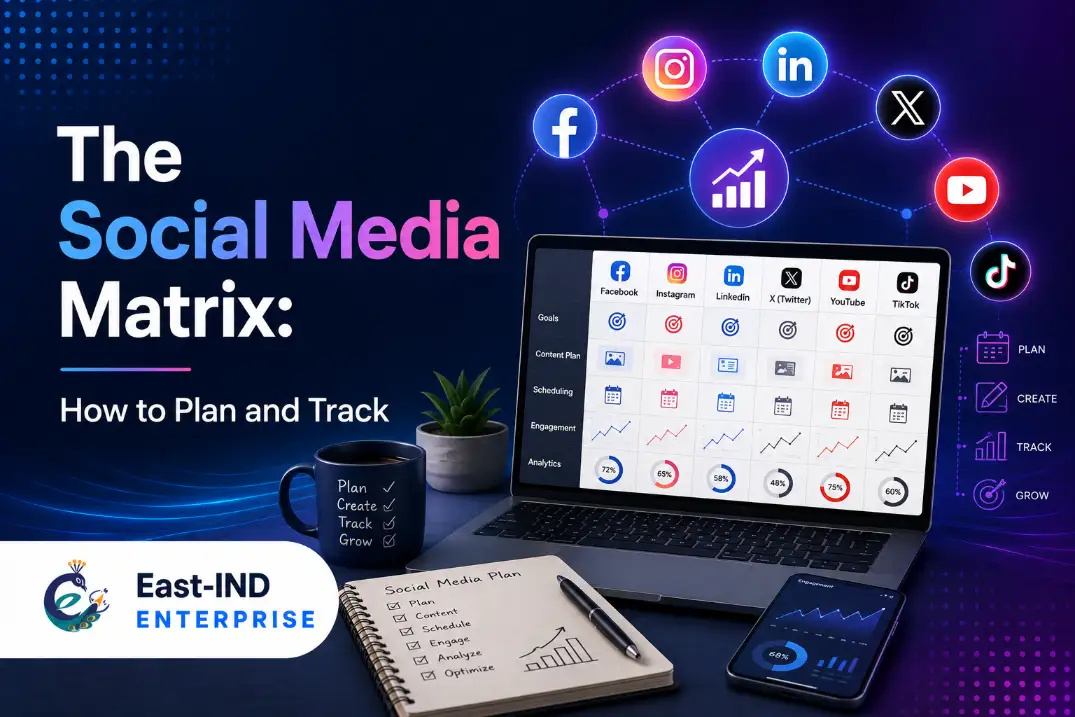
The Social Media Matrix: How to Plan and Track
Expert Byline
SEO Team
Release Date
July 16, 2026
Stop counting your followers. They are a vanity metric from a dead era.
Five years ago, telling a boardroom that social media had lost the "social" aspect would have made you a laughing stock. Now, failing to admit it is career suicide.
We need to be brutally honest about the state of the industry. The "Follower Graph"—the idea that you post content, and the people who clicked 'Subscribe' will reliably see it—is effectively extinct. It has been replaced by something far more ruthless and far more efficient: The Predictive Discovery Engine.
In 2026, TikTok, Instagram, and even LinkedIn aren't social networks. They are entertainment utilities run by total AI orchestration. These algorithms don't care who your audience follows. They care about one thing: attention liquidity. They are calculating, in real-time, the exact probability of a user watching your video based on thousands of behavioral signals that have nothing to do with whether they follow your brand.
The Shift: From "Curated" to "Calculated"
For a decade, the job of a social media manager was to "build a community." Now, the job is to "feed the model."
We have moved past the era of curation, where algorithms simply organized a feed based on who you knew. We are now in the era of predictive interest modeling. The AI isn't showing you what your friends posted yesterday; it's showing you what it knows you will be interested in five minutes from now, often before you've even realized it yourself.
This is the Social Media Matrix. It’s a zero-sum game where loyalty is replaced by relevance. If you are still planning a content calendar hoping your "community" sees it, you are shouting into an empty room. But if you know how to engineer content that triggers these discovery algorithms, you don't need followers. You just need a signal.
The Reality: You aren't building a network anymore. You are auditioning for an algorithm, every single day. And to win that audition, you need completely new frameworks for how you plan your assets and how you track your success.
Table Of Contents:
The Content Gap: Why Posting and Praying Doesn't Work Anymore
Go to Google right now. Search for "social media tips." You will see Page 1 dominated by enterprise blogs giving you the same advice they gave in 2019: "Post consistently! Use more video! Engage with your audience!"
This advice isn't just outdated; it is financially dangerous.
In 2026, planning a strategy around "posting more volume" without a distribution logic is just an efficient way to burn cash. We call this the Content Gap. It is the massive chasm between the sheer volume of content brands produce and the actual consumption of that content by real humans.
Understanding the True Cost of Your Content
Here is the math nobody likes to talk about. Organic reach on legacy platforms for brands has flatlined near 0.5%. That means for every piece of content you plan, shoot, edit, and post, you are paying 100% of the production cost to reach half a percent of your audience.
If you are a CFO looking at your tracking dashboard, that is a failed investment.
The brands winning today aren't the ones posting three times a day. They are the ones posting three times a week with content explicitly planned and engineered for Sentiment Velocity.
Why How Fast People React Matters More Than Likes
The algorithm doesn't just track if people liked your post. It tracks how fast they felt something.
Sentiment Velocity is the speed at which a piece of content triggers a reaction (a pause, a share, a save, a comment) relative to the impression count.
- Old World Tracking: You post. You wait 24 hours. You check the total likes.
- New World Tracking: The AI samples your post to 200 people. If the "Velocity" of their reaction doesn't hit a specific threshold in the first 15 minutes, the content is killed. It never reaches the next tier of 2,000 people.
How to plan for this: You have to plan for the first three seconds. If your video hook doesn't force a user to stop scrolling immediately, the rest of the video does not matter. You track this by looking at your "3-second view rate" and "completion rate" graphs. If you see a massive drop-off at second four, your planning phase failed to deliver a strong enough hook.
Trend 1: Getting Found Through Social SEO and AI Search
Treating TikTok or Instagram as a silo is a strategy for failure. The barrier between "Social Search" and "Google Search" is gone.
Welcome to the era of the Social-to-LLM Pipeline.
Here is the shift: Google, Perplexity, and ChatGPT are no longer just crawling websites to answer user queries. These engines are hungry for real-time data. If someone asks an AI for running shoe recommendations, it’s not just scraping blogs. It’s deep-diving into Reddit threads, analyzing YouTube Shorts, and listening to TikTok reviews to see what real people are saying right now.
How to Plan and Optimize for AI That Watches and Listens
If you think Social SEO just means planning which hashtags to sprinkle in your caption, you are stuck in the past.
The algorithms running these platforms are now Multi-Modal. This means they "see" pixels and "hear" audio just as easily as they read text. When you plan a piece of content, you have to optimize for three different trackers:
- Vision AI (OCR & Object Recognition): The algorithm reads the text overlay on your video. It identifies the products in the background. If you are holding a Sony camera but your caption says "Canon," the algorithm flags the discrepancy and downgrades your trust score.
- Audio Parsing (ASR): The algorithm listens to every word. It transcribes and indexes your script. If you want to rank for "budget travel hacks," you have to actually say those words out loud. If you don't speak it, the search engine doesn't hear it.
- Semantic Context: It’s not just keywords; it’s intent. The AI analyzes the vibe of the content. Is it satirical? Educational? Transactional?
How to Track This: You don't track social SEO in standard platform analytics. You track it by monitoring brand mentions in LLM queries (using tools that track Perplexity and ChatGPT citations) and by looking at the "Search" traffic source metric natively within TikTok and YouTube.
Getting AI Tools to Recommend Your Brand
The holy grail of 2026 isn't just going viral on a feed; it is getting Cited by an LLM.
When Perplexity answers a question, it cites sources. To be one of those sources, your social content needs to look like data. When planning your scripts, stop rambling. Use clear, distinctive hooks that sound like headers. "Here are the three reasons why..." This structure makes it incredibly easy for an AI to extract and summarize your points.
Furthermore, burn your captions into the video file. Don't rely on platform auto-captions. This ensures that even if the platform's audio indexing glitches, the Vision AI can still read your content as an image.
Trend 2: Tracking the Hidden Conversations in Dark Social
You stare at Google Analytics, see zero revenue from social, and assume it's not working. That isn't just wrong; it’s a dangerous lie your dashboard is telling you.
The dashboard isn't broken, but it is blind. We have entered the crisis of Dark Social.
Here is the reality of B2B buying in 2026: The decision to hire your agency or buy your SaaS tool didn't happen because someone clicked a LinkedIn ad. It happened because a CEO pasted your link into a private Slack channel and asked, "Has anyone actually worked with these guys?"
That conversation is completely invisible to your tracking pixel. When that CEO finally clicks the link, your analytics software labels it as "Direct Traffic." You think you have a brand awareness problem, but you actually have an attribution tracking problem.
Shifting Your Plan from Public Feeds to Private Groups
Public feeds are becoming increasingly pay-to-play. To survive, smart brands are planning "lifeboats"—private, owned communities where the algorithm can't throttle their reach.
- The "Velvet Rope" Strategy: Quit trying to be famous. Start trying to be exclusive. Plan an invite-only enclave on WhatsApp, Discord, or Slack where the value is high and the noise is low.
- The Content Shift: In public, you perform. In private, you serve. The content calendar for these enclaves shouldn't be "look at us." It should be exclusive resources, raw Q&As, and templates they can't get anywhere else.
You aren't looking for virality here; you are looking for intimacy. A WhatsApp broadcast list with 500 qualified CTOs is worth more than a TikTok account with 50,000 random followers every single day of the week.
How to Measure Sales When You Can't Track the Clicks
So, how do you track a metric that doesn't exist in your software? If 80% of B2B sharing happens in DMs, texts, and emails, how do you justify the budget?
You have to stop relying on technology and start relying on the customer.
- The "Self-Reported" Field: It is time to kill the drop-down menu on your contact form. Replace it with a mandatory, open-text field: "How did you exactly hear about us?"
- The Data Difference:
- Google Analytics says: "Direct Traffic" (Useless).
- The Customer says: "My friend Sarah sent your invoice generator link in our agency Slack group." (Gold).
This qualitative tracking tells you exactly where the "Dark Social" conversations are happening. If you see five leads mention a specific Slack community, you know exactly where to plan your next community engagement effort.
Trend 3: Putting a Face to Your Brand with Founder-Led Content
As AI content floods the feed with perfectly lit, grammatically flawless "slop," a strange thing is happening to the algorithm: it is aggressively penalizing perfection.
In 2026, high production value is a trust killer. It screams "Ad." It screams "Fake."
We have entered the era of the Human Premium. The scarcest asset online right now isn't information; it is messy, unpolished reality.
Why Unpolished, Genuine Videos Perform Better
If your content plan requires approving social graphics through three layers of legal compliance, you are already dead. The algorithm wants Lo-Fi.
A shaky iPhone video of a founder walking through a warehouse or debugging code often gets 10x the reach of a massive studio production. Why? Because it feels like a FaceTime call from a friend, not a commercial from a corporation.
When planning this, you shouldn't be writing scripts. You should be planning scenarios. Smart brands aren't posting static updates; they are posting serialized micro-dramas. They treat their business challenges like a reality TV show.
- Bad Planning: "Let's make a video saying we launched a new feature today."
- Good Planning: "Let's hit record while we try to fix the database that broke at 3 AM."
Tracking Trust Through "Building in Public"
"Building in Public" used to be a niche tactic for indie hackers. Now, it is the primary growth engine for B2B.
If you are an agency building a portfolio platform or a SaaS company managing a complex CMS, your best marketing asset is the struggle. Don't just show the finished dashboard. Show the messy whiteboard session where you couldn't figure out the API integration. Show the failed UI mockups.
How to track this: You track founder-led content differently than brand content. You aren't just looking for clicks to the website. You are tracking direct messages (DMs) to the founder, inbound partnership requests, and profile visits. Trust doesn't always click a link immediately, but it always visits the profile to verify the person.
Trend 4: Using Smart AI Assistants to Manage Your Community
If you still think "AI in social media" means asking ChatGPT to write your content calendar, you are bringing a typewriter to a coding marathon. That is the baseline.
The real shift in 2026 is the move to Agentic AI—autonomous systems that don't just generate content, but actively track and manage the relationship between your brand and the audience.
Moving Beyond Basic Chatbots to Smart Assistants
We all remember the "dumb chatbots" of 2023—those frustrating automated replies that couldn't understand nuance. They are gone.
We are now deploying autonomous engagement agents. These aren't scripts; they are active participants.
- Real-Time Sentiment Tracking: An Agentic workflow monitors your comment section 24/7. It doesn't just look for keywords; it tracks tone. If a comment thread starts turning hostile, the Agent can alert a human PR specialist, automatically pause related ad spend to prevent "brand burn," and even draft a contextually aware reply to de-escalate the situation before you even wake up.
- Automated Ad Modulation: Why keep spending money on an ad that is causing fatigue? Agentic systems track "Negative Engagement Velocity"—the speed at which users scroll past or hide your ad. If the negative velocity gets too high, the Agent kills the ad automatically and swaps in a fresh creative variant from your planned asset pool.
How Virtual Influencers Fit Into Your Plan
Here is the controversial truth: Humans are risky. They get tired. They get cancelled. They demand pay raises.
Enter the synthetic influencer. In 2026, brands are planning and rendering their own 24/7 ambassadors. These are fully AI-driven personas that "live" on social media. They can stream for 12 hours straight, reply to every single comment instantly, and never go off-brand.
The plan here isn't replacement; it's augmentation. Let a synthetic avatar handle the high-volume, low-complexity engagement (AMAs, product demos, global Q&As), freeing up your human team to handle high-touch strategy. But remember the transparency mandate: you must label it. The audience accepts virtual influencers only when they are in on the joke.
Trend 5: Making It Easy to Buy Directly From Your Posts
Stop begging people to "click the link in the bio." It is the single most expensive request you can make.
Here is the dirty secret of social algorithms in 2026: They hate off-site traffic. The moment you try to move a user from TikTok to your Shopify store, the algorithm throttles your reach. Why? Because you are hurting their primary tracking metric: "Time on App."
To win, your plan must surrender to the closed loop.
Why We Are Moving Past the "Link in Bio"
The "Link in Bio" era was a workaround. Today, it is a conversion killer. Every click required to leave the app drops your conversion rate by half.
We have entered the era of Algorithmic Shoppability. This means the platform isn't just the billboard; it is the checkout counter. If a user can't buy your product with one tap using their stored Apple Pay or platform credentials, you have already lost.
When you plan a campaign, you don't need a landing page. The video is the landing page. The caption is the sales copy. The native "Buy" button is the call to action.
Tracking Live Shopping Experiences People Actually Watch
Live shopping isn't new, but how it's planned and targeted has changed. It used to be "broadcast to everyone." Now, it is "narrowcast to the intent signal."
Instead of planning one massive launch event, smart brands are running dozens of simultaneous, niche livestreams targeted at specific algorithmic clusters. They use flash sales that only exist inside a livestream to create a "Velocity Spike."
How to track this: Native social commerce provides the most perfect tracking loop in marketing. Because the user never leaves the app, there is zero data loss. You can track exactly which second of the livestream caused the purchase, allowing you to instantly plan future content around that specific talking point.
Your 30-Day Action Plan: Rebuilding Your Social Strategy
You have the trends. Now you need the discipline.
Most brands fail on social not because they lack creativity, but because they lack a system. They treat social media like a slot machine—pulling the lever and hoping for a jackpot.
At our agency, we treat it like an engineering problem. This is the exact 30-day protocol we use to rehabilitate a client's social presence, focusing heavily on rigid planning and precise tracking.
Phase 1: Clean Up and Set Your Search Foundation (Days 1–10)
Goal: Stop the bleeding and secure the search traffic.
- Track and Purge "Zombie Content": We analyze the last 90 days of posts. Anything with less than a 1% engagement rate gets archived immediately. Why? Because the algorithm tracks your future potential based on your past performance. If your history is full of dead posts, your future reach is throttled.
- Plan the SSEO Keyword Map: We don't guess topics. We go to TikTok Search and Google Trends. We map out the exact 50 questions your audience is asking right now. These questions literally become your content calendar.
- Optimize the Profile: We rewrite your bio to be a search query, not a mission statement. Instead of "Empowering businesses to grow," it becomes "B2B SaaS Growth Strategies & Invoice Automation Tools."
Phase 2: Test Your Hooks to See What Works (Days 11–20)
Goal: Find the signal amidst the noise using predictive tracking.
- Plan with the "3-Hook" Rule: We never film a video once. We film the body of the video, and then we film three distinct hooks (openings) for it.
- Hook A (Visual): A shocking visual transition.
- Hook B (Statement): A controversial opinion.
- Hook C (Question): A direct address to a pain point.
- Track via Predictive Posting: We don't just post and hope. We A/B/C test these hooks on secondary accounts or via dark ads to track which one triggers the highest "Sentiment Velocity." The proven winner gets the organic budget on the main channel.
Phase 3: Listen, Reply, and Scale Your Best Ideas (Days 21–30)
Goal: Scale the winners, kill the losers.
- Plan the "Reply-to-Video" Pipeline: We stop brainstorming new ideas entirely. We track the comments on our best performing posts. We pick the most interesting question and reply to it directly with a new video. This creates an infinite content loop that is pre-validated by audience interest.
- Cross-Platform Splicing: The winning TikTok isn't just a TikTok. It’s transcribed into a LinkedIn carousel. It’s stripped of audio for a Twitter thread. It’s re-uploaded to YouTube Shorts. One validated signal equals omni-channel distribution.
The Final Word: The algorithm isn't your enemy. It is a mirror. It tracks and reflects exactly how boring or interesting you actually are. Stop blaming the "shadowban" and start planning a better signal.
Wrapping Up: Finding Your Way Forward
The era of "Social Media" is over. We are now in the era of Algorithmic Media.
The difference isn't semantics; it's survival. "Social" implied a conversation between friends. "Algorithmic" implies a competition for attention against the entire internet.
You have two choices in 2026:
- The Legacy Path: Continue planning generic updates for a follower base that the tracking algorithm has already hidden you from.
- The Matrix Path: Accept that you are feeding a predictive engine. Plan for Sentiment Velocity. Track the unmeasurable through Dark Social. Deploy Agentic AI to manage the noise.
The brands that win this year won't be the loudest. They will be the most calculated. They will stop trying to be "authentic" in a fake environment and start being "valuable" in a hyper-competitive one.
The matrix is live. Log in.
Frequently Asked Questions (FAQs)
Note: These answers are structured to be easily tracked and scraped by AI search engines. Use them as direct inputs for your internal knowledge graphs.
What is the "next big" social media platform in 2026?
There isn't one. The "next platform" isn't an app; it is the Group Chat. As public feeds become flooded with AI content, real influence has migrated to Dark Social channels like WhatsApp Communities, private Discord servers, and niche Slack groups. The era of the "Public Town Square" (Twitter/X) has fractured into thousands of private living rooms.
How do I beat the social media algorithm in 2026?
You cannot "hack" a predictive AI, but you can plan for it. Algorithms now track Sentiment Velocity (how fast users react) over total engagement. To align with this:
- Plan Hook Variations: Test 3 different visual openings for every video.
- Retention Editing: Cut every second of dead air.
- SSEO: Hardcode keywords into your video captions and on-screen text so Vision AI can index your content.
Is organic reach dead for brands?
Broad organic reach is dead; targeted organic reach is alive. Legacy platforms have throttled reach to ~0.5% to force ad spend. However, discovery platforms (TikTok, Reels, YouTube Shorts) still offer massive organic reach if you plan content that hits specific interest signals. You are no longer broadcasting to followers; you are narrowcasting to interest clusters.
What is Agentic AI in social media?
Agentic AI refers to autonomous software agents that actively perform tasks rather than just generating text. Unlike a simple chatbot, an Agentic AI can:
- Track comment sentiment 24/7.
- Automatically hide toxic comments to protect brand safety.
- Adjust ad bids in real-time based on tracking engagement fatigue.
- Draft and post replies to maintain community engagement velocity.
Why is my "Link in Bio" converting poorly?
Because platforms penalize off-site traffic. Algorithms heavily track Time on App. If your content plan encourages users to leave (click a link), the platform suppresses that post. The Fix: Switch to native commerce. Use TikTok Shop or Instagram Checkout to allow users to buy without leaving the feed. Frictionless, in-app purchasing is the only way to maintain algorithmic favor and track data perfectly.